
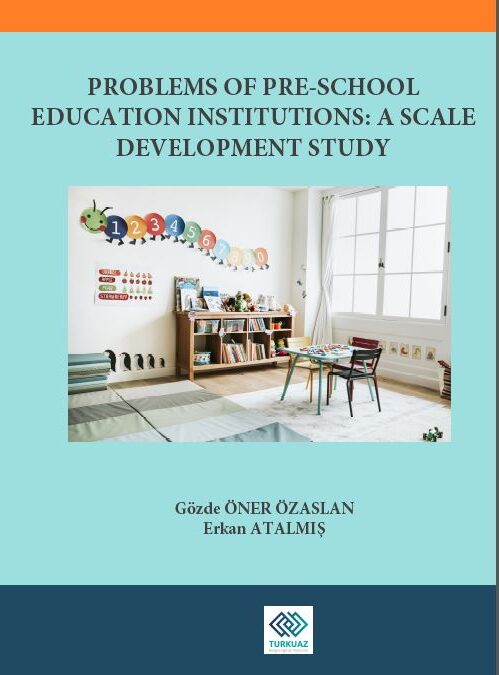
PROBLEMS OF PRESCHOOL EDUCATION INSTITUTIONS: A SCALE DEVELOPMENT STUDY
📝 Yayın Şekli/Publication Type
⚖️ Lisans Türü/License Type
🌐 Yayın Dili/Publication Language
🔢 ISBN
🔗 DOI
🛒 Satın Al
📄 PDF İndir
📚 Kitap Tanıtımı
PROBLEMS OF PRE-SCHOOL EDUCATION INSTITUTIONS: A SCALE DEVELOPMENT STUDY
Yazar(lar): Gözde ÖNER ÖZASLAN, Erkan ATALMIŞ
Eser, okul öncesi eğitimin çocuk gelişimi ve toplumsal ilerleme için taşıdığı stratejik önemi merkeze alarak okul öncesi eğitim kurumlarında karşılaşılan sorunları sistematik biçimde görünür kılmayı amaçlar. Giriş ve kuramsal bölümler; okul, aile ve çevre etkileşimini; okul öncesi eğitimin amaç, ilke ve kazanımlarını; fiziksel çevre–sınıf düzeni–bahçe olanakları, yönetim süreçleri ve yöneticilik yeterlikleri, öğretmen niteliği ve mesleki destek, öğretim süresinin sürekliliği, destek personeli ve aile katılımı/ev ziyaretleri gibi belirleyici boyutları kapsamlı bir literatür taraması eşliğinde çerçeveler. Bu zemin üzerinde kitap, alan yazında yaygın bir boşluğa işaret ederek kurumların sorun alanlarını tanılamaya dönük özgün bir ölçme aracı geliştirir; problem alanlarını haritalandıran ölçek boyutlarıyla hem uygulayıcılara (yönetici-öğretmen) hem de politika yapıcılara eyleme dönük bir rehber sunar. Son bölümler, okul öncesi kurumların fiziksel kalite standartları, iletişim ve aile katılımı mekanizmaları, okul iklimi ve liderlik başlıklarında iyileştirme için öneri setleri derler; böylece kurumların öğrenme ortamı kalitesini, çocukların okula hazırlık ve esenlik düzeylerini artırmaya yönelik somut yol haritaları ortaya konur.
Okuyucu Kitlesi:
Okul öncesi öğretmenleri ve yöneticileri, il/ilçe MEB birimleri ve denetçiler, okul geliştirimi ve kalite ekipleri, aile danışmanlığı ve PDR birimleri, eğitim politikası uzmanları, eğitim fakülteleri ve araştırmacılar.
Anahtar Kelimeler:
Okul öncesi eğitim; kurum sorunları; ölçek geliştirme; fiziksel çevre; okul iklimi; eğitim yönetimi; aile katılımı; destek hizmetleri.
📝Book Promotion
PROBLEMS OF PRE-SCHOOL EDUCATION INSTITUTIONS: A SCALE DEVELOPMENT STUDY
Authors: Gözde ÖNER ÖZASLAN, Erkan ATALMIŞ
Positioning early childhood education as a cornerstone of child development and social progress, this book surfaces the recurring problem areas within pre-school education institutions and offers a structured roadmap for improvement. The theoretical chapters synthesize research on school–family–community relations and outline the aims and principles of pre-schooling, while unpacking critical dimensions such as the physical environment and classroom layout (including outdoor spaces), school leadership and administrative processes, teacher capacity and professional support, continuity of instructional time, auxiliary staff, and parental involvement/home visits. Against this backdrop, the volume addresses a notable gap in the literature by introducing a purpose-built diagnostic scale that maps institutional problem domains and translates them into actionable guidance for practitioners and policymakers alike. The concluding sections consolidate quality standards for settings, mechanisms for parent–school communication, and leadership/ climate levers, yielding practical recommendations to enhance the learning environment, boost children’s school readiness and well-being, and guide evidence-informed institutional development.
Target Readership:
Pre-school teachers and leaders; local/national education authorities and inspectors; school improvement and quality-assurance teams; guidance/counseling units; education-policy specialists; faculties of education and researchers.
Keywords:
Early childhood education; institutional problems; scale development; physical environment; school climate; educational leadership/management; parental involvement; support services.
📝 Kitap İçeriği/Book Content
- CONTENTS PREFACE ………………………………………………………………………v
- CHAPTER ONE
- 1. INTRODUCTION ……………………………………………………1
- 1.1. Problem Statement ………………………………………………2
- 1.2. Aim of the Research ……………………………………………4
- 1.3. Importance of Research ………………………………………5
- 1.4. Counts ………………………………………………………………6
- 1.5. Limitations …………………………………………………………7
- 1.6. Definitions …………………………………………………………7
- CHAPTER TWO
- 2.PREVIOUS RESEARCH ON THE SUBJECT……………9
- 2.1. Related Studies Carried Out in Turkey …………………9
- 2.2. Related Studies Abroad ……………………………………19
- CHAPTER THREE
- 3.THEORETICAL EXPLANATIONS …………………………23
- 3.1. Preschool Education …………………………………………23
- 3.1.1. Definition of Preschool Education …………………23
- 3.1.2. Importance of Preschool Education ………………24
- 3.1.3. Basic Principles of Preschool Education …………25
- 3.1.4. Objectives of Preschool Education …………………27
- 3.2. Preschool Education Institutions …………………………28
- 3.2.1. Importance of Preschool Education Institutions28
- 3.2.2. Physical Environment in Preschool Education Institutions …………………………………………………30
- 3.2.3. Importance of Physical Environment ……………31
- 3.2.4. Qualifications to be Present in the Physical
- Environment ………………………………………………33
- 3.3. Family in Preschool Education ……………………………36
- 3.3.1. Family Involvement ……………………………………38
- 3.3.2. Home Visit as a Family Involvement Event ……43
- 3.4. Preschool Teacher ……………………………………………45
- 3.5. Administration …………………………………………………47
- 3.5.1. Education and School Administration ……………47
- 3.5.2. School Administrator …………………………………50
- 3.5.3. Administrators of Pre-School Education Institutions …………………………………………………56
- 3.6. Training Personnel, Expert and Master Educators …60
- CHAPTER FOUR
- 4.METHOD …………………………63
- 4.1. Model of the Research ………………………………………63
- 4.2. Universe and Sample …………………………………………63
- 4.3. Operation …………………………………………………………65
- 4.4. Data Collection Tools ………………………………………65
- 4.4.1. Personal Information Form …………………………66
- 4.4.2. Scale of Problems of Preschool Education Institutions …………………………………………………66
- 4.5. Collection of Data ……………………………………………66
- 4.6. Analysis of Data ………………………………………………67
- CHAPTER FIVE
- 5.FINDINGS …………………………69
- 5.1. Findings of the First Sub-Problem ………………………69
- 5.2. Findings on the Second Sub-Problem …………………73
- 5.3. Findings on the Third Sub-Problem ……………………73
- 5.3.1. Teachers’ Views on the Problems of
- Preschool Education Institutions According to Gender Variables …………………………………………74
- 5.3.2. Teachers’ Views on the Problems of Preschool
- Education Institutions According to Marital Status Variables ………………………………76
- 5.3.3. Teachers’ Views on the Problems of
- Preschool Education Institutions According to Age Variables …………………………79
- 5.3.4. Teachers’ Views on the Problems of Preschool
- Education Institutions According to the Variables of the Professional Seniority Year …………………81
- 5.3.5. Teachers’ Views on the Problems of Preschool
- Education Institutions According to School Type Variables ……………………………………………………85
- 5.3.6. Teachers’ Views on the Problems of Preschool
- Education Institutions According to Support Personnel Variables ……………………………………87
- 5.3.7. Teachers’ Views on the Problems of Preschool
- Education Institutions According to Class Sizes90
- CHAPTER SIX
- 6.CONCLUSION, DISCUSSION AND SUGGESTIONS93
- 6.1. Conclusion and Discussion …………………………………93
- 6.1.1. Conclusion and Discussion of the First Sub Problem………………………………………………………93
- 6.1.2. Conclusion and Discussion of the Second Sub Problem………………………………………………………94
- 6.1.3. Conclusion and Discussion of the Third Sub Problem………………………………………………………97
- 6.1.3.1. Conclusion and Discussion of the First Point of the Third Sub-Problem ……………97
- iv
- 6.1.3.2. Conclusion and Discussion of the Second
- Clause of the Third Sub-Problem …………98
- 6.1.3.3. Conclusion and Discussion of the Third
- Clause of the Third Sub-Problem …………98
- 6.1.3.4. Conclusion and Discussion of the Fourth Point of the Third Sub-Problem ……………99
- 6.1.3.5. Conclusion and Discussion of the Fifth Point of the Third Sub-Problem …………100
- 6.1.3.6. Conclusion and Discussion of the Sixth Point of the Third Sub-Problem …………101
- 6.1.3.7. Conclusion and Discussion of the Seventh Point of the Third Sub-Problem …………101
- 6.2. SUGGESTIONS ……………………………………………102
- REFERENCES ………………………………………………………105